Every business has one person who holds all the context. Here is how to clone their brain.
By Lucas Imrie
Most businesses do not have a knowledge problem. They have a retrieval problem. The information exists. It is just locked in someone’s head.
Usually, it is whoever does the selling. They take the calls, do the site visits, have the coffee that quietly decides the scope of the whole project. Then everyone else spends the next six months tapping them on the shoulder to ask what was agreed.
That person is not disorganised. They are a bottleneck of context, and every business has at least one. The cost shows up as clients repeating themselves, handovers that leak, and a team that slows to a crawl the week that person goes on leave.
So we started building brains for those people.
The 3 Streams
The principle is simple. Everything that person says and hears gets captured automatically, and all of it feeds one searchable place. No notes, no discipline required. If it needs someone to remember, it will not last.
Online Meetings
A recorder like Granola sits on every call and transcribes it, with transcripts landing in the cloud automatically. This is the easy one, and most businesses already have it.
Where they go wrong is leaving the transcripts inside the app, where only the person who took the meeting ever looks at them.
The Inbox
This used to be the hard one. It is now the easiest thing in the stack, because you can connect an email account straight to an AI model in a couple of minutes using a connector. The fancy term is MCP, which essentially lets AI talk directly to your apps.
No pipeline, no export, no developer. Just a way to talk to your inbox using a chatbox.
In Person and on Calls
This is the stream everyone misses, and it is usually where the important stuff happens.
Site visits, coffees, the conversation in the car park after the meeting formally ended, and the phone calls that never had a transcript. Until recently, capturing one meant putting the thing on speaker and hoping, which is not something you do in front of a client.
We solve this with a Pocket AI, a small recorder that magnetises onto the back of your phone. One button records a call as it comes in, and the same device picks up in-person meetings.
For us, that has meant every quick “one small change” call from a developer is now on the record. Those are precisely the calls that turn into scope arguments three months later.
Three streams come together to feed one searchable brain.
How to Turn It Into Something You Can Talk To
There are two ways to do this, and the first is easy enough that anyone can do it.
The Easy Way
Connect Granola, your Pocket, and your inbox directly to Claude or Codex using their MCP. It is just in settings, under connectors. You can connect them up, log in, and have it running in an afternoon.
Retrieval is a bit slower because the model is going off and searching each source when you ask, but it works completely fine, and you own nothing you have to maintain.
The More Efficient Way
Set up embeddings, which means indexing everything in advance so answers come back near instantly instead of after fifteen or twenty seconds.
This is what I run at Flipside. It is genuinely quicker, but it is a build, and it is not where anyone should start.
Bonus
If you need help setting it up, you can simply use this prompt:
“I want one searchable brain of every meeting, call, and email I am part of. I use Granola for online meetings, a Pocket AI recorder for calls and in-person meetings, and Mail for email. Walk me through connecting all three to you using MCP, one step at a time.”
Then you can simply chat to your brain:
“What did the client say about the timeline in March?”
“Did we promise three rounds of revisions or four?”
“Did we ever agree to include the extra floor plan, or did we just talk about it in a meeting?”
The answer comes back as what was actually said, not someone’s memory of it. Those are different things, and the gap between them is where most scope disputes live.
It Goes Far Beyond Simply Answering Questions
Once the model has the full history of a project, it can produce work using that context instead of you briefing it from scratch every time.
When we put together a brochure for a client, we are not starting from a blank page and my recollection of what they wanted. Every call, every email, every site visit is already there.
What they said about the buyer they are targeting, the finishes they liked and the one they hated, the change of direction in week three that never made it into the brief. The first draft comes back already carrying all of it.
The same applies to follow-ups. After a long call, a fifteen-second request produces a summary and a next-steps email that references the specifics the client actually raised, with the context of every previous call sitting behind it, rather than a machine-written generic version everyone can tell.
It also does the handover documents nobody wants to write. Sales to delivery, a proper brief instead of a summary of a summary. You can further connect your CRM and other apps to create additional automation.
The recording gets you accuracy. The context gets you output.
What This Actually Fixes
The gain is not the recording. Recording is trivial, and half your team is probably doing it already.
The gain is that the context stops being a person.
Clients Stop Repeating Themselves
Nothing erodes confidence faster than a client explaining the same requirement to a third member of your team.
Handovers Stop Leaking
When a job moves from sales to delivery, the brief is usually a summary of a summary. Now the delivery team goes to the source.
Your Key Person Can Leave the Country
Not metaphorically. The reason most owner-led businesses cannot take a proper holiday is that they are the retrieval system.
Before You Hit Record
A few things need to be right.
Recording laws vary by state and usually need everyone’s consent, so tell people and check the rules where you operate. Nobody has objected once I explain why we are doing this.
Decide what does not get recorded, too. A wearable has no idea when the meeting ended and the private chat began.
And always keep every stream automatic. A brain fed by hand dies inside a month.
Where to Start?
Do not roll this out across the business.
Pick the one person who gets interrupted for answers most often, and build it for them alone.
Start with the meeting recorder, since transcripts start piling up immediately. Add the inbox next, because it is now a ten-minute job. Add the wearable last, once the team is comfortable with the idea.
Give it a month, then ask everyone else what they stopped needing to ask about.
The models everyone can buy are converging. Before long, the intelligence available to you is the same intelligence available to your competitor.
The only durable difference is what it knows about your business specifically, and that has to be accumulated.
Every week you do not capture is a week you cannot get back.
Worth doing for anyone in your business who is a bottleneck of context.
About the Author
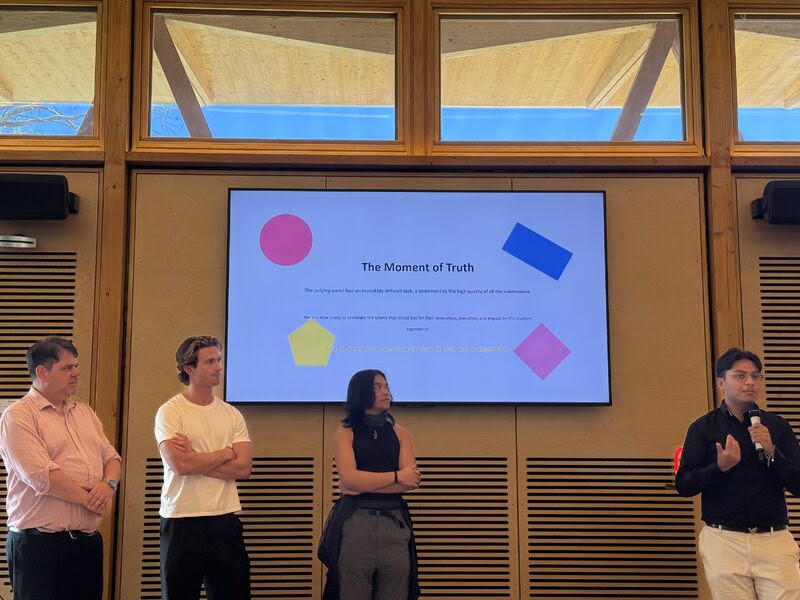
Lucas Imrie is a Sydney-based AI builder and entrepreneur. He runs Render Works, an AI-optimised render studio for property developers, and Flipside AI, his AI strategy and creative brand. He was named Sydney’s best AI automation agency by APAC Insider and has judged university AI agent competitions.